





Press Release
Government’s First 100 Days Show Promise, but Lack of Clear Roadmap
on Accountability and Anti-Corruption Raises Concerns: TIB
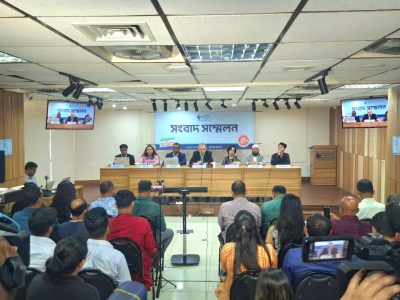
Dhaka, 7 June 2026: Transparency International Bangladesh (TIB) has observed that while the first 100 days of the new government formed after the 13th National Parliamentary Election show some positive intent toward good governance and a corruption-free state, there are clear signs of backtracking in institutional reforms and accountability mechanisms. TIB shared these observations while presenting its observation-based report titled “The First 100 Days of the Government Following the 13th National Parliamentary Election: Delivering on Commitments to Good Governance and Anti-Corruption” at its Dhanmondi office today.
The review assessed the BNP-majority government’s first 100 days in light of its 31-point reform agenda and election manifesto, covering Parliament, the executive, judiciary, local government, human rights, anti-corruption measures, right to information, media freedom, and institutional performance.
The program was attended by TIB’s officials – Dr. Iftekharuzzaman, Executive Director; Professor Dr. Sumaiya Khair, Adviser, Executive Management; Muhammad Badiuzzaman, director, Research & Policy; Md. Julkarnayeen; Senior Research Fellow; Razia Sultana, Research Fellow; Sahidul Islam, Assistant Research Fellow, while Mohammad Tauhidul Islam, Director, Outreach & Communication, moderated the session.
The report highlights several positive steps, including the abolition of duty-free vehicle and plot privileges for MPs; reduction of VVIP protocol for the Prime Minister; directives for officials to bear personal costs for private travel using state facilities; mandatory 9:00 a.m. office attendance; agreements with three countries to recover laundered money and asset seizure in another country; and the decision to implement the Ninth National Pay Scale in three phases. In Parliament, 1,778 of 2,509 questions were answered and 280 MPs participated in debates, which the report terms encouraging.
At the press conference, referring to the overall assessment that the government’s first 100 days are promising and full of potential, TIB Executive Director Dr. Iftekharuzzaman said, “At the highest levels of government, some commendable, unprecedented, and new-style leadership examples have been observed. However, it is difficult to conclude that the government is being or will be run in a fundamentally new way as a result. Several actions and initiatives of the government are inconsistent with the BNP’s election manifesto, the 31-point state reform pledge, and the objectives of the July Uprising—particularly the expectation of establishing a good-governance-based, corruption-free, and accountable government—which is a matter of serious concern for the public.”
He further said, “Of the 133 ordinances enacted during the interim government period, 97 were directly turned into laws in the first parliamentary session. However, important ordinances related to the judiciary, the Human Rights Commission, the Anti-Corruption Commission (ACC), and the prevention of enforced disappearances were either repealed or suspended under the pretext of further review. These ordinances had created opportunities for ensuring government accountability to the public. On the other hand, controversial ordinances that would increase executive control were passed, ignoring stakeholders’ expectations, which is a complete departure from the government’s core commitments.”
He added, “For a long time, key institutions such as the ACC, the Human Rights Commission, and the Information Commission have remained stagnant due to the suspension of top-level appointments or failure to restructure them. In continuation of past politicization practices, concerns have also been raised over the appointment of the Governor of Bangladesh Bank, the appointment of administrators in local government institutions, decisions that effectively weaken local government by introducing MPs’ inspection rooms in Upazila Parishad offices, the appointment of vice-chancellors in universities, and even the reorganization of various professional bodies along political lines. In addition, despite commitments and efforts to maintain law and order, the recurrence of mob culture, extortion, land grabbing, and the ‘now it is our turn’ culture, along with the administration’s failure to prevent violence by extremist religious forces, is also a matter of concern. We expect the government to give due importance to these issues and to make sincere efforts to strengthen institutional frameworks that support the establishment of a good-governance-based, corruption-free, and accountable government.”
The observation says parliamentary accountability has weakened due to the absence of most standing committees, while special committees remain dominated by the ruling alliance. Conflicting political statements over Article 70 reforms and the July Charter have added uncertainty. Judicial independence has also been questioned after the dissolution of the Supreme Court Secretariat and related institutional changes.
It also notes that politically motivated cases continue alongside rapid withdrawal of cases against ruling party members, while journalists and dissenting voices face legal harassment. Despite meritocracy pledges, civil administration continues to reflect political influence in transfers, promotions, and contractual appointments.
In the financial sector, the appointment of the central bank governor linked to political and business interests has raised concerns. The Bank Resolution Act 2026 has been criticized for allowing owners of weak banks to regain control without accountability, while loan rescheduling practices remain largely unchanged.
During the first 100 days, 188 journalists faced harassment in 130 incidents, with 12 cases filed and 7 arrests. Concerns have arisen over potential violations of freedom of expression through the misuse of controversial provisions of the Cyber Security Act 2026. In addition, during the redesign of the Chief Adviser’s Office website, important government documents and data from the interim government period were removed from online access and moved to an archive, which has made it more difficult to ensure proactive and easy public access to information.
On law and order, March–April 2026 saw 294 hijack, 605 murders, 196 abductions, and 3,496 cases of violence against women and children. Despite a stated crackdown on mob violence, 69–80 incidents were recorded nationwide, including attacks on shrines and Baul communities, resulting in 31–42 deaths. The controversial statement by the Minister of Road Transport describing extortion as a “compromise” has further encouraged this crime. In addition, no effective initiatives have been observed in addressing the measles crisis in the health sector or in preventing corruption.
At the press conference, TIB strongly urged the government, formed in the wake of the July mass uprising, to fulfill all its election manifesto commitments and other promises through a clear and specific roadmap, reflecting the spirit of anti-discrimination and the public’s expectations.
Media contact:
Mohammad Tauhidul Islam
Director, Outreach and Communication
Phone: 01713107868
Email: tauhidul@ti-bangladesh.org

